Peace Corps Volutneers are all just dirty hippies that have a "save the world" mentality. At least that's what many expats here and a good deal of people back home probably think.
"But we're not dirty!" is what I say. Well, at least not all the time...and what's so wrong with having a superman mentality? Someone's gotta give a shit about others, right?
Last month my group (LR-3) had our IST (In-Service Training) in Kakata. Among other things, we were shown some video clips about typical Americans' views on foreign aid and the U.S.'s role in international developemental efforts. While service in the PC is a very unique experience, different from other types of international development work, what we are doing can stull be included in talk like this.
So take a couple minutes and watch these clips. Take note of your thoughts.
1.) What Americans Think About Foreign Aid: East
...and because I'm from the Midwest...
2.) What Americans Think About Foreign Aid: Midwest
I think in the beginning, you'll find you agree with some of these people's opinions. Why help others when there's so much that needs to be done at home? Yes, it's a valid point, one that I agreed with initially, and I'm serving as a PCV in Africa. But just keep watching...do your thoughts change? Are you surprised by what you learn?
Do you really think we're doing enough? Should we be doing more? Do you understand now, at least small-small, why people choose to serve as a PCV?
Share the facts with others. Continue to support our work and other developmental efforts. Don't only think and function within your own bubble of reality. We're all part of this world, we're all sharing this human experience together. Do what you can to help, even if it's small. Every bit counts.
Sunday, November 10, 2013

No Mo Pen-Pens in Monro
This past week the Liberia National Police (LNP) issued a motorcycle ban for all the main streets of Monrovia. For more information, check out this BBC article about the ban. The motorcycle ban in Monrovia is a good idea in theory, but did these people really think about the potential effects before they enacted the ban? Probably not. Just like everything else here. As a pedestrian and taxi passenger, I appreciate that the roads are clearer and safer. However, taxi prices are going up (although only small-small, it's still an unexpected incerase) and people are literally stranded on the roads, waiting for a ride. This isn't happening just in central Monrovia either; in the surrounding transportation hubs, like Red Light and Duala, the roads are even more congested than ever. The overflow of people must now join the market vendors, who already take over a good portion of the road, causing for even less space on the already-crowded roads for the cars. It boils down to a simple conclusion: there are just too many people and not enough taxis. (If only there could be more mass transit options, such as buses, if only!) As I write this, I'm sitting in the PC Office in Congo Town, one of the outlying municipalities of Monrovia. To get back to my village in the bush, I have to take at least 4 different taxis: first from Congo Town through Sinkor to the central downtown area (Broad St.), then to Duala (I'm so looking forward to the traffic), then to Tubmanburg where the coal tar ends, then finally through a bumpy, muddy, rocky road back to Gbarma. And all that really isn't bad at all! Fortunatately, I'm one of the PCVs that lives near the capital, one the the "lucky west-siders". But let's see how getting back to site this afternoon goes. I estimate 5-6 hours. Maybe I should start working on that teleportation invention now....
Saturday, October 19, 2013
Ha oho na matata.
All the photos I have from the safari in Kruger National Park, from my birthday in Swaziland, and from the remainder of my trip throughout the eastern part of South Africa can be viewed here.
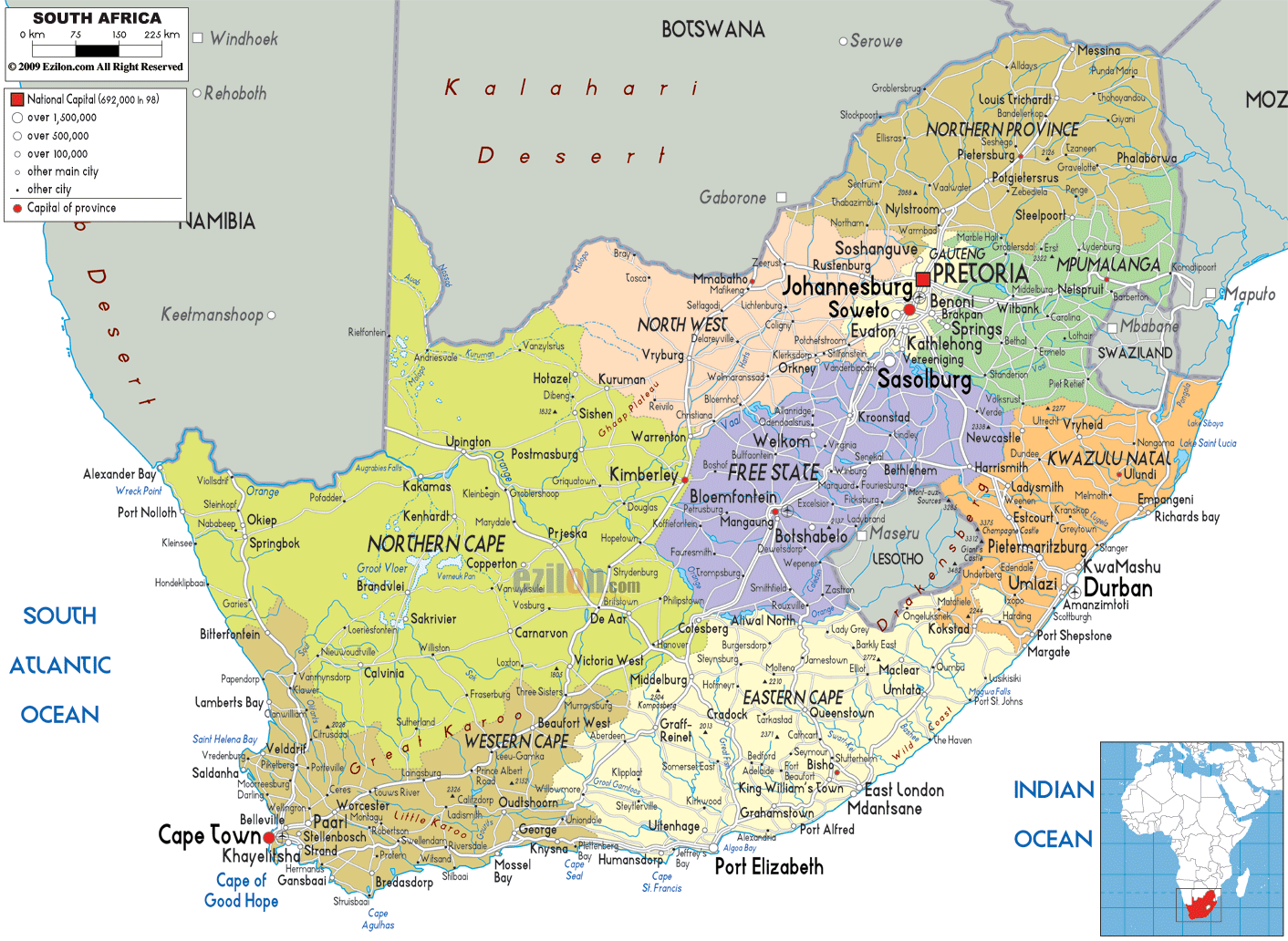
To get a better understanding of where I traveled, check out this map:
 We splashed around in the water for all of ten minutes before a saw some storm clouds rolling in, so we headed back to the BP, but at least I collected some cool sea shells before we left! That night, we went out for sushi and I had THE BEST MILKSHAKE of my entire life. And then I got sick from it (or the sushi or the combination of the two) for nearly a week. Totally worth it though.

Honestly, it was a bit
strange for me. “There were so-so white people,” as we’d say here in Liberia, and I'm not used to interacting with large groups of them anymore. (Is that weird? How am I going to be able to handle coming back to America?!) The majority of them were speaking Afrikaans, which I had
never heard being spoken before, so that was interesting. One thing I noticed at the festival and didn’t
particularly like was that more of the festival-goers were the white,
Afrikaans-speaking people, the black South Africans that were there were working in the some of
vendor tents and shacks, and both groups mostly kept to themselves. But I'm sure if you really look for it, you'll find that sort of self-segregation anywhere.
To get a better understanding of where I traveled, check out this map:
 |
| From: http://www.ezilon.com/maps/images/africa/political-map-of-South-Afri.gif |
The morning of my birthday, we packed up at the backpackers
in Swazi and headed back into South Africa. By that afternoon we had reached
our next destination, St. Lucia, the world’s largest estuary. We relaxed small,
then went out for deliciously cheesy pizza dinner with a group of newly-made international
friends from the BP. Then Sadie and I (rather enthusiastically) made a giant
bowl of guacamole while Joy photo-documented the night and Maren went hunting for
Lefty, the one-eyed cat at the BP.
 |
| A Guac-tastic Night |
The next day we went on a nice, hour-long walk to the beach.
We had finally reached the Indian Ocean!

After St. Lucia, we made our way to the quaint town of
Clarins, where even the trees are kept warm!

Then we made our way to Bloemfontein, one of the larger cities
in the Free State province. The last night all four of us were together, we
went to a festival at the University of the Free State.
 |
| Joy, Sadie, Maren, and Me at the Festival |
At this point in the trip, Maren was going to fly home and
Sadie had to return back to her site in Lesotho to begin school. Unfortunately, there just wasn't the time or the funds for Joy and I to see Sadie's site, so Joy and I
stayed in Bloem for an extra day. We went back to the festival and ate multiple types of foods on a stick, including donuts, waffles, and chips. A bit of Americana had made its way to South Africa!
To get back to Johannesburg, where I had to fly out a few days later, Joy and I took an overnight bus. We had our new South African friend, Milton, come pick us up from the bus station at 4 A.M. (We met him in St. Lucia on my birthday, and he offered to help house us if the need came up...which it did since I had practically no money at the end of my trip.) I had never stayed with a couch surfer before, but I would definitely recommend it! Milton was so warm and welcoming and literally saved me from having to sleep in the Joburg bus station for the last 3 nights of my trip.
Why can't more people back home be as genuinely helpful?
Milton took Joy and me to the Joburg Botanical Gardens for a picnic one day, and we enjoyed delicious food and interesting conversation with people from all over the world. The next day, I was invited for lunch and tea time with his family and had a great conversation with Milton's mother, Michelle, who also gave me some books I could use as resources for ideas for income-generating activities with my Girls Club here in Liberia. It was refreshing to interact with people who were so helpful and expected absolutely nothing in return.
While I never made it to Lesotho ("Leh-su-tu"), Sadie taught me a phrase in her local language, Basotho ("Ba-su-tu") during my time down there. The phrase is reminiscent of Disney's "Lion King" (and a bit cheesy, admittedly), but it encompasses something that was reinforced for me during the last leg of my trip in South Africa. "Ha oho na matata" means "There are no worries." I really didn't need to stress out about money during the end of my vacation thanks to my incredible friends and the goodwill and generosity of complete strangers. All my worries from the end of the trip simply vanished because people looked out for me. Things like this reinforce the faith I have in others. I now know that when a sticky situation arises, others will be there to help you out. Someway, somehow, you'll make it through.
25th Birthday in Swaziland
If you would’ve asked me as a kid where I’d be when I was 25,
never in a million years would my answer be “in Africa”. Now I’ve been living
in Liberia for 16 months and have traveled to South Africa, Swaziland, and
Ghana. How incredible is that?
 |
| Customs Checkpoint Entering Mbabane, Swaziland |
 |
| Swazi Flag |
Alright, so the morning of my birthday, I woke up just
before dusk to go on a short run around the backpackers in Mbabane ("Ma-ba-neh"), the capital
of Swaziland. Let me tell you, I have definitely acclimatized to tropical West Africa and down south it was COLD. Never did I think I’d job wearing gloves in Africa! I ran on some winding roads, climbing up and
down the red, rocky, dusty hillsides and was fortunate enough to be able to see the sun rise from behind a mountain backdrop. It which was gorgeous. I also spotted a monkey running up a tree,
which I found surprising because the area was residential, and then I almost run up
into a tree, too. "Why?" you ask. Well, because a giant, scary guard dog was barking
ferociously at me and started chasing me. Fortunately, it was in a
fenced-in yard, however I didn’t notice the fence until AFTER my heart skipped a couple beats and I screamed. Thank goodness for that fence!
 |
| View of Mbabane |
When I finished my run, I could see the steam rising from my
skin up into the cold, foggy, morning air. I stretched small out on the gravel
road, then walked back inside the BP, singing to myself the end of a hip-hop song I had been listening to on my run. As I entered the BP, I was met with a surprise birthday
breakfast! I sat on the floor of the dining area and stretched some more while
the girls sang me “Happy Birthday”. When I stood up, I fully surveyed the spread on
the table, and this is what I saw:
 |
| The Breakfast of Champions |
The day before, we visited a craft market, which was a really interesting experience. In Liberia, there aren’t really any crafts that are locally-made. Beads come from China, clothing items come from the States, and the lappa fabric comes from Guinea. So, I was a little more than excited to be able to buy some authentic, locally-made crafts, and consequentially, that’s where the majority of my money was spent during the trip. (I literally had $0.40 US in cash when I left South Africa at the end of my trip and no plastic. Not smart, I know, but somehow at all worked out.) I was purchasing items that I could use to decorate a U.S. house I don’t even have yet!
Anyways, we separated and went into different shacks to browse the stock of items for sale: paintings, figurines, bowls, jewelry, fabrics, etc. I began chatting with the women, asking their names and about the process of producing the crafts I was interested in purchasing. This helped me get brownie points while haggling! The vendors were much less aggressive than those from Liberia, and I found that just taking the 30 seconds to chat with them small when you first walked into their stall made a world of difference. I learned that one of the woman’s cousins makes all the crafts she sells and another woman’s name begins with a click! (How cool is that?!) I even found myself using small Liberian English while talking with them, which has a different cadence and intonation than the English spoken in Swazi, of course, but it seemed to help. Also, once I mentioned that I was visiting from Liberia, West Africa, that usually got me brownie points, and I was able to talk them down a little more. So I didn’t get as ripped off as I could have. I am SO my father's daughter.
 |
| In the Craft Market |
South African Safari
In late June the school year ended. With tests corrected and
final grades submitted, I had survived my first year of teaching and my first year
of living in Liberia. It was time for a much-needed vacation. So I headed to
South Africa and Swaziland for 2 weeks in early July. I arrived in Johannesburg,
South Africa on the Fourth of July and was reunited with some close friends I
hadn't seen in a long time. Here are
some photos of our airport reunion!
 |
African Sisters: Me and Sadie, an Education PCV in Lesotho
|
Thanks, Sadie, for planning EVERYTHING for our fantastic trip. :-)
 |
Maren and Me, After Multiple Embraces and Tears of Joy
|
Maren didn't know I was coming until the day I arrived. You should’ve seen me try to sneak up behind her
in the airport that day. People
were staring at me as I peered out from behind these giant marble columns,
trying not to topple over from the weight of my backpack. Let’s just say the
surprise wasn't executed all that well on my part, but the reunion itself was
priceless.
The fourth member of our group, Joy, unfortunately got stuck
stateside for a bit and would join us the next day. Once she joined us, our
party of Trumanite grads went road-trippin’ small through South Africa and
Swaziland together for just under 2 weeks.
On my first full day in South Africa, I got to go on a safari!
We woke up at 5 A.M. to make our way to Kruger National Park,
which is northeast of where we were staying in Nelspruit. If anyone ever wants
to go to KNP and stay with a very lovely family for an affordable price, go to Nelspruit Backpackers! Our tour guide,
Paul, runs the BP with his wide, Natalie, and they were so very friendly and
helpful. I learned so many things from Paul during the safari itself…I just couldn’t
write fast enough! During the two-day safari, I scribbled down as many facts as
possible during the bumpy ride throughout the park. We camped there one
night in the Skukuza Campsite. In Shangan, one of the local languages there, “skukuza”
means “he who turns everything upside down”, and it was the name given to the
white people that first came to the area. Sounds about right, eh?
Overall, the safari was probably my favorite part of the entire trip, so that's why I'm going to highlight some of the cools facts I learned from Paul while at KNP right here. For all the wildlife-loving, bio-nerds out there
like me, I hope you enjoy this!
- The “Big Five” game animals in Africa include the rhino, elephant, buffalo, lion, and leopard, and we were fortunate enough to see ALL of these amazing creatures during out short safari.
- The white rhino was the first animal we saw there. It takes 70 bites per minute of low-lying vegetation.

- Starlings are blue, iridescent birds that are always near rhinos, and ox-pecters have a mutualistic relationship with their large friends, as they eat parasites right off the rhino’s skin!
- The black rhino is more endangered than the white rhino and has some different characteristics than its fairer cousin. There is no back-of-the-neck bump, it eats leaves so it holds its head up higher, and its mouth is narrower. It’s practically blind and this animal can get aggressive once provoked, which happens easily.
- Male bull elephants have such high levels of testosterone in their bodies that it makes them go a bit crazy. Their coordination gets compromised, so sometimes they drag one of their legs as they walk. Full-grown adults have seven sets of molars and get the last one when they are about 50. They live to be about 70 years old (woah!), and they essentially die from malnutrition when their teeth wear down. Females also have a 22-month-long gestation period and once their babies are born, they can’t control their trunks their entire first year of life. (Thank goodness the gestation period for humans is NOT 22 months. Can you imagine that? I wonder if that would serve as a population control measure if that were the case….)

I digress.
- The spots on giraffes get darker as they get older, and their lifespan is around 25 years. So if I were giraffe, I’d be an old lady about to kick the bucket.
- Female hyenas have higher levels of testosterone than males, which makes them bigger and stronger and more dominant during mating. Due to this, the scared males literally run away from the females immediately after copulation finishes! Also, hyenas can digest bones! Isn’t animal physiology just fascinating?!
- The lilac-breasted roller is a perfect example of sexual dimorphism exhibited in male birds.

- Here’s a snippet from my journal the second day of the safari: “We just saw a pride of five females and
three cubs walk right by our vehicle. They posed on the road for us, and we
could’ve reached out and touched them! Ah! 3:05 P.M., Sat., July 06, 2013.”
While it was awesome to be so close to such beautiful, powerful animals, we
made sure to keep all limbs inside the vehicle at all times. The animals in KNP
are used to the cars, trucks, and jeeps and don’t feel threatened by them. Even
if they would be comfortable around humans outside of the vehicles and would
come up to lick you like a friendly housecat, you wouldn’t want that. “Why?”
you ask. Because the tongue of a lion is so rough that if it were to lick you,
it would rip your skin off. (“Shit,” I said when I heard this. “That would really suck.”)


(All lion photo credits go to Maren.)


Sunday, June 30, 2013
World Map Project
 |
| GCS World Map |
This past semester I began my secondary
project, which is a girls club at my school, Gbarma Central High
School. As a new organization, I chose for us to do the World Map
Project, which serves to provide the community with a (MUCH-needed)
geographical resource. Now our town will see that the female youth
actually CAN make a positive impact in their community. The process of
the WMP also helped teach my girls many skills, ranging from time
management to painting. Click here to see the photos from the first project of GCS
Girls Club ("The Golden Girls").
Photo Dump #9


Thursday, June 20, 2013
Happy Anniversary to Me...and All of Lr-3!
Yesterday, June 19th, the new group of PC
Trainees (PCTs) arrived in Liberia. I know I speak for most―if not all―of us
who are a part of the PC Liberia family when I say that we are so happy and
excited they are finally here! We have all been counting down their arrival for
months and are looking forward to train them with the skills and resources they
need so they can help us continue to improve the education sector of this
country.
I was at Robertsfield International Airport yesterday, along
with 7 other PCVs and some PC Staff, to welcome the new group, LR-4, as they
came walked out the large iron gate into the parking lot. Luckily for them, it
was overcast and slightly breezy. (When my group, LR-3, arrived, it was sunny,
hot, and not windy at all. We were not a pretty sight after that long flight
and the circus that was baggage claim for 36 people with 1 carousel in a
crowded room. Can you say, “sweat-y!” Anyway,
I digress….) It was so nice to see all 39 of their faces light up as we shouted
“Peace Corps” and “Welcome” to them to get their attention. Us PCVs held up
welcome posters and helped shuttle people to the buses so they could be on
their way to Kakata to start their PST. While some of them admittedly looked
tired from the long flight, the feeling of enthusiasm was there, as thick as
the humid Liberian air. They boarded the bus and had a nice welcome ceremony at
Kakata, complete with kola nuts and coconuts. I hope they enjoyed their first
night in Africa!
~~~~~
June 8th was the 1 year mark of my LR-3’s arrival
in country. It’s a bit strange to think we’ve been here that long and to think
we’re at the halfway mark. While the days do seem to pass slowly, the weeks just
fly by. While year 1 wasn’t always a piece of cake, I’d say it was a great year
overall. Now I know what I want (and do not want) to do in year 2, and I have a
much better idea of how things will go in the classroom here. Now that we’ve
all got a year of teaching under our belts, we have the confidence to make the
necessary changes to enhance our effectiveness with our students. While I am
looking forward to having a break during the summer vacation, I am anxious to
see how things will improve in the classroom next school year. I believe things
can and will only get better. :-)
Photo Dump #8
Here are some photos from the past few months. Enjoy!
Let's Go to the Beach! (Robertsport, Grand Cape Mount County)
April & May Randoms (Gbarma, Gbarpolu County & Kakata, Margibi County)
Let's Go to the Beach! (Robertsport, Grand Cape Mount County)
 |
| View From My Hammock |
April & May Randoms (Gbarma, Gbarpolu County & Kakata, Margibi County)
 | |
| Banana Cupcakes! (made in tomato paste cans) |
Friday, May 24, 2013
Put Your Hands Up!
Check out this video our PCVL (PC Volunteer Leader) John O'Malley created and put online. It's a pretty good visual representation of life here in Liberia. I hope it helps give you an idea of what it's like to be here serving as PCVs. :-)
Thursday, May 23, 2013
Everybody pot boiling, but my pot can’t boil!
Here's a sampling of one of the ridiculously catchy Liberian tunes that can be heard from morning 'til night:
Pot Can't Boil
(lyrics)
And here's "the Gbarma boys" version, featuring Thomas, one of my 8th graders:
Pot Can't Boil
(lyrics)
And here's "the Gbarma boys" version, featuring Thomas, one of my 8th graders:
Enjoy!
Sunday, April 21, 2013
Photo Dump #7
This group of photos is small-small compared to previous ones. I just don't have enough time and the internet is too slow at the moment to upload any more. I'll do some more the next time I have internet access, most likely mid-June. Until then, I hope these will keep you satisfied!
 |
| Here's one of the many local art pieces in our house. Gbarma Town is in Gola Country, fyi. |
 |
| Cynthia (my neighbor) and I, representin' the STL! This girl has got an arm and she's only 11 years old! |
Tings Dat Na Too Fine-Oh
Some words I would use
to describe being in Liberia include: loud,
colorful, and friendly. However, der are some tings I cannot love too much.
1.) Excessive Beating
of Young Children
Parents here beat the
shit out of their kids. They don’t properly discipline their kids (reprimanding
them at the appropriate moment when the bad behavior is occurring, like you
should do with dogs), and usually just give them empty threats. They then let
their anger and frustration grow. Once it stews inside the parents for a couple
days, the littlest thing can set them off; some Liberian parents are like
ticking time bombs. One wrong action and BAMB! They erupt. They shout
vulgarities at their children, and while some are admittedly a bit funny, like
“I will flok [flog] you until you poo-poo-oh!”, others are much more cruel, such
as “You must learn to respect yoself or you will neva do anyting good in yo
life and you will become a prostitute!” Then the physical beating ensues. Our
neighbor has beaten her daughter, who’s 11, with her slipper (flip-flop),
switches of various lengths and thicknesses, and her hands. She’s probably used
other objects too. Listening to the sound of a child getting a beating right
before bed and then listening to them getting yelled at first thing again the
very next morning just plain sucks.
2.) Public Defecation
and Urination
While I’ve become
desensitized to this, as it’s a daily occurrence, knowing all this human waste
is getting into the community’s local water sources, especially during the
rainy season, is still unsettling. Each morning, I unlock the wooden shutter to
my window and as it’s swinging open, there are many mornings I see a child squatting
and taking their morning dump. Sometimes mothers will scoop it up with a shovel
and fling it into the bushy area across our street, but most of the time, it’s
just left there. I just taught my eight grade about germ transmission and ways
to maintain both personal hygiene and community/environmental health. I had to
start small-small and define the word feces before I could even explain why it’s
so bad for it to just be all over the place! I am very grateful for indoor
plumbing and sewage systems. I will never take that for granted after this
experience!
3.) Chunking the Dirt
Anywhere and Everywhere
People here don’t take
out the trash; they chunk the dirt. And the majority of people don’t do it in a
mass dumping ground area. There are more small-piles of trash but open pits
aren’t often dug into the ground. The trash hardly ever gets buried and just
continues to pile up. Sometimes trash gets burned, which smells terrible. Littering
here isn’t even seen as a bad thing and is seen as normal behavior. People find
it strange when I hoard my trash at school or elsewhere to carry it to the
house to throw it our wastebasket. I miss recycling and now value it so much
more than I ever have.
4.) The “There’s Always
Tomorrow” Mentality
There isn’t always tomorrow, though! Some of
my fellow teachers and administrators in my school have the reading
comprehension and speed of a middle school student back home, and many students
can’t spell most words correctly, let alone construct a simple sentence
correctly. They don’t understand how to use capitalization and punctuation
correctly, and their grammar is horrendous. It makes sense, because the
Liberian English they speak is drastically different from the Standard English
they are taught (poorly) in school. Students are promoted just to keep
filtering them up through the school system, and due to this, they enter the
higher grades lacking basic foundations such as numeracy and literacy.
Sometimes it is not their fault, as their previous teachers promote them when
the skills are not there, and sometimes the students are at fault, because they
bribe their teachers to promote them to the next grade, usually with money and
sometimes with sex.
Regardless, the
capacity of the youth in this country is greatly lacking, and while we are
trying to help, I sometimes feel as if we’re fighting an uphill battle. It’s hard
to not be cynical, but I sometimes question the effectiveness of our presence
(Peace Corps, other NGOs, etc.). Even if we are making an impact, the
developmental progress we’re making isn’t something tangible in the
here-and-now. Maybe we’ll see some improvements in the long-run. Maybe literacy
will have improved in 50 years, and unemployment won’t be at 80%, but it’s hard
to tell. It’s difficult not to feel jaded, but I really don’t know if being
here is the best use of American tax dollars. I don’t think my students will
really remember the content of the lessons I teach them, but hopefully they
will learn some “life skills”, such as honesty, organization, respect (towards
themselves and others), and the value of hard work and dedication to an
end-goal. Maybe in 50 years the population of the country won’t be primarily
made up of uneducated, impoverished youth. (Currently, 60% of the country is
under the age of 35, and many people live under $2 USD/day.) And hopefully by
that time, more people will be literate and less people will be living in
poverty.
5.) Students That Make
Fun of the Way We Speak
“No, I don’t like speaking
like an idiot, but yes, I have to do it so you can understand me,” is the
response I want to give students when I hear them cussing (insulting) me in
class, but I don’t. Instead I explain to them that “I know the way I can speak
is sounding different but I must speak in dis way so dat you will understand
me. I na like to speak in dis way. I am tryin to use da Liberian English
small-small and I know it can sound funny and strange to you but if I speak da
Standard English, you will not be getting me when I speak.”
It’s just irritating
when they cuss me and then I have to go over one of my “Class Values”--respect,
what it means and why it’s important--again, for the umpteenth time. Then there are the few times I get so vexed and
tell them I don’t appreciate the insults because I did not leave my home and my
family and my friends in America to come to Africa to deal with rude children.
Then I also say I sometimes can think the way they are speaking is funny and
strange, but I will not cuss them, so don’t cuss me. Then I think, “wow, I really overreacted and let my emotions get
the best of me…I shouldn’t be so sensitive, they’re just kids,” but then in
other instances I think, “Those ungrateful little turds are so disrespectful,
rude, and unappreciative of the sacrifices I’m making to be here!” I can’t
speak for other PCVs here, but I’m sure we all face similar situations and go
through the same emotional rollercoaster at times. But that’s what we have to
deal with here.
While there are many things
that are extremely frustrating and/or challenging, I don't want you to get the idea that everything is bad here all the time. It's not at all. I'm just saying things can get rough at times, but one can only hope and try to
stay positive that improvements will come. The only way Liberia can go is up,
and with the right partners and guidance, we have to believe we’ll get there
sooner rather than later.
Friday, March 15, 2013
Photo Dump #6
Click here to see the latest photos from my time back at site, in Gbarma.
Here's a preview:
 |
| Pre-celebration photo of some of the Royal Ladies, the birthday club we're in. From left to right: Bendu, Rachel, Fatu, and me. |
 |
| Musician from VP Joseph Boakai's Office plays a song for the female Gola country devil to dance to. |
 |
| 11th Grade Mitosis Dance: Prophase |
 |
| 11th Grade Mitosis Dance: Metaphase |
 |
| 11th Grade Mitosis Dance: Anaphase (AKA, time to dance!) |
 |
| 11th Grade Mitosis Dance: Telophase |
 |
| Students at devotion prior to school. |
Subscribe to:
Posts (Atom)